When the snow melts, the Val d'Aran swaps skis for boots and becomes one of the finest summer mountain destinations in the Pyrenees. Here's what a warm-season visit looks like. For winter, see when to ski.
Hiking & the high mountains
The same slopes that ski in winter become walking country from roughly June to October — trails climb from the villages into flower-filled high valleys, and the long-distance GR-11 trans-Pyrenean route passes through the valley. Just south lies the Aigüestortes National Park, Catalonia's only national park, a landscape of glacial lakes and granite peaks. Our Val d'Aran summer hiking guide sorts the walks by difficulty and covers the high refuges you can string them between.
One of the valley's signature summer walks climbs the Artiga de Lin, a glacial valley south-west of Vielha, to the Uelhs deth Joèu ("Jupiter's Eyes", 1,658 m) — a dramatic resurgence where meltwater bursts back out of the mountainside. The water comes off the glacier on Aneto (3,404 m), the highest peak in the Pyrenees: it vanishes underground at the Forau d'Aigualluts on the far side of the range and travels some 4 km through the limestone before re-emerging here, a link the caver Norbert Casteret proved in 1931 by dyeing the water. This is one of the sources of the Garonne — the great river that rises in the Aran and flows north through France to the Atlantic, giving the valley its green, Atlantic-side character.
Closer to the resort, the Circ de Colomèrs is the signature glacial-lake walk on Baqueira's doorstep. From Salardú a forest track climbs the Aiguamòg valley to the Banhs de Tredòs, from where a summer 4x4 taxi — running roughly mid-June to mid-September for about €5 per person — shortens the approach to the Refugi de Colomèrs. From the hut, the classic circuit of seven lakes takes about two hours, with longer loops for keen walkers, and it's gentle enough to be a genuine family day out among the estanys.
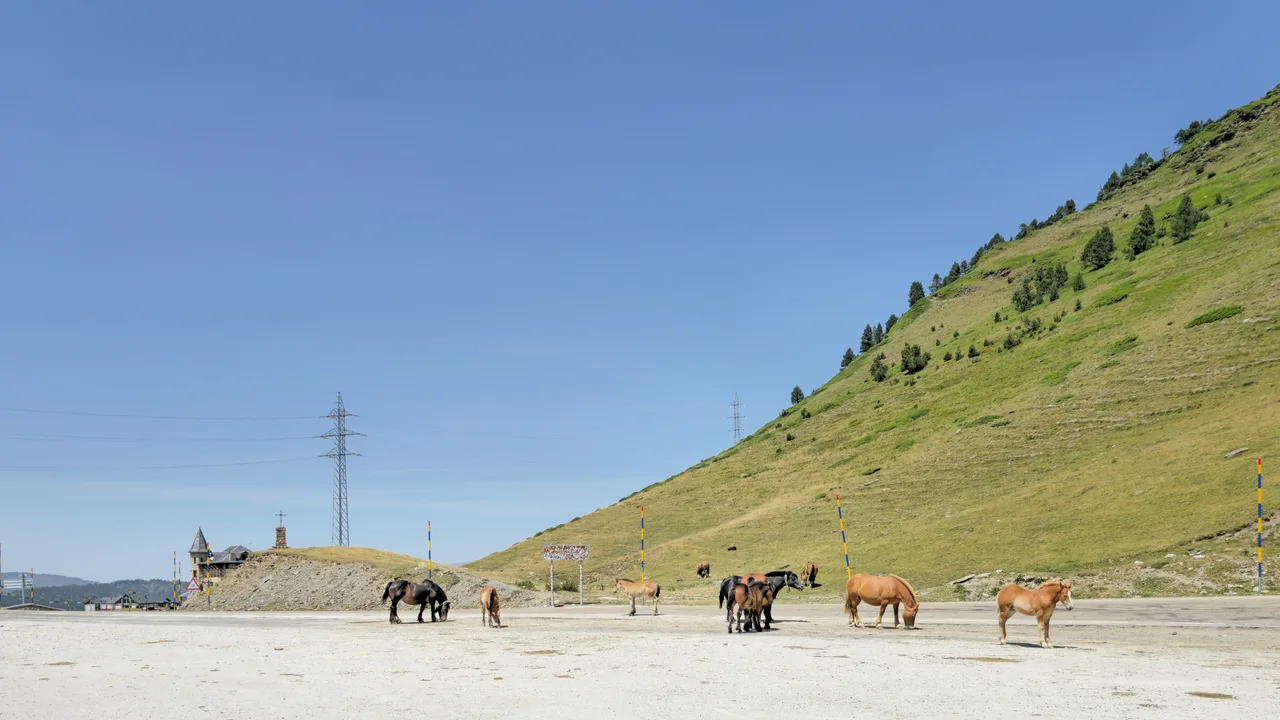
An easier, gentler classic starts right at the ski area. From the Pla de Beret an almost-level path follows the infant Noguera Pallaresa — the valley's Mediterranean-bound river — down to Montgarri, an isolated hamlet abandoned in the 1950s whose 16th-century sanctuary, with its octagonal bell tower, still stands at the head of the valley. It's about a 10 km round trip, a popular family walk in summer and a beginner-friendly cross-country skiing and snowshoe route in winter. The Pla de Beret is, in fact, a genuine continental watershed: springs barely a stone's throw apart send water to two different seas — the Garona/Garonne north to the Atlantic, the Noguera Pallaresa south to the Mediterranean.
Cycling & the passes
The Port de la Bonaigua (2,072 m) is a celebrated road climb, and the valley's quiet roads and the Vielha tunnel make the Aran a summer cycling base, with signposted routes for both road bikes and mountain bikes. Some lifts also run for mountain biking and sightseeing.
Trail running — the Pyrenees' capital
In early July the valley becomes the epicentre of Pyrenean trail running: the HOKA Val d'Aran by UTMB stages seven mountain races, from short loops to punishing ultras, as a European Major of the UTMB World Series (its 2026 edition ran 1–5 July). Even if you're not racing, it's a spectacular time to be in the valley, with a festival atmosphere in Vielha and runners strung across the high trails.
Adventure & the rivers
The green, Atlantic-fed valley is also a watersports and adventure base. Guided rafting descents run the Garona (Garonne) through the lower Aran — the classic stretch between Les and Pont de Rei, about 8 km of fun rapids and calmer pools — and outfitters also offer canyoning, via ferrata and rock climbing in the side valleys. For families, the Naturaran adventure park strings treetop circuits, rope bridges and climbing walls through the forest, finishing with a 250-metre zip line.
Villages, baths & festivals
Summer is when the valley's culture shows: the medieval villages, the thermal baths at Arties, and — on the night of 23 June — the Festes del Foc (Haro & Taro), the Val d'Aran's UNESCO-listed summer-solstice fire festivals.
Frequently Asked Questions
Is the Val d'Aran worth visiting in summer?
Yes — it's a superb Pyrenees summer destination: hiking and cycling, the Aigüestortes National Park's glacial lakes, the Bonaigua pass, medieval villages and thermal baths, with far fewer crowds than winter.
When is summer in the Val d'Aran?
Roughly June to October for walking and cycling, with July and August the warmest and busiest. The high trails are clearest from about July.
What are the Val d'Aran fire festivals?
The Festes del Foc (Haro & Taro), on the night of Sant Joan (23 June) — part of the 'Falles del Pirineu' inscribed by UNESCO as Intangible Cultural Heritage in 2015, where villages burn a great tree trunk to mark the solstice.
Is there trail running in the Val d'Aran?
Yes — the HOKA Val d'Aran by UTMB, a European Major of the UTMB World Series, brings seven mountain races to the valley in early July (1–5 July in 2026), making it the trail-running capital of the Pyrenees. There are marked routes to run or hike year-round in the season, too.
What adventure activities can you do in the Val d'Aran in summer?
Plenty beyond hiking: guided rafting on the Garona river (the Les–Pont de Rei stretch, about 8 km of rapids), plus canyoning, via ferrata, climbing and cycling. For families, the Naturaran adventure park offers treetop rope circuits and a 250-metre zip line.
Where does the Garonne river start?
The Garonne rises in the Val d'Aran. One of its celebrated sources is the Uelhs deth Joèu in the Artiga de Lin valley, where meltwater from the Aneto glacier — after sinking underground at the Forau d'Aigualluts on the far side of the range and running about 4 km through the rock — resurfaces before the river flows north into France and on to the Atlantic. It's a popular summer walk from the valley.