The best of the Val d'Aran isn't only on the pistes. Below the ski area, the valley strings together a set of medieval stone villages with grey-slate roofs, Romanesque churches and a culture — and a language, Aranese (a variety of Occitan) — found nowhere else in Spain. In fact each of the valley's 33 villages has its own church, an exceptional collection of 11th–13th-century Romanesque built when the Aran was a crossroads of Pyrenean trade — you can follow them as an "Aran Romanesque route." Here are the ones to know.
Salardú
The handsome medieval capital of the Naut Aran (Upper Aran), Salardú clusters around the 12th–13th-century church of Sant Andreu, home to the celebrated Christ of Salardú — one of the finest Romanesque wood carvings in the Pyrenees. The closest characterful village to the lifts, and a fine base.
Arties
Where two rivers meet, Arties is known for two things: its natural thermal springs — open-air pools of warm (~39°C) sulphur water beside the Garonne, with the high Banhs de Tredòs (at 1,750 m, billed as Europe's highest thermal spa) a short drive up the valley — and some of the best eating in the valley. Stone houses, a Romanesque church and a riverside setting make it a favourite for an off-slope evening.
Unha
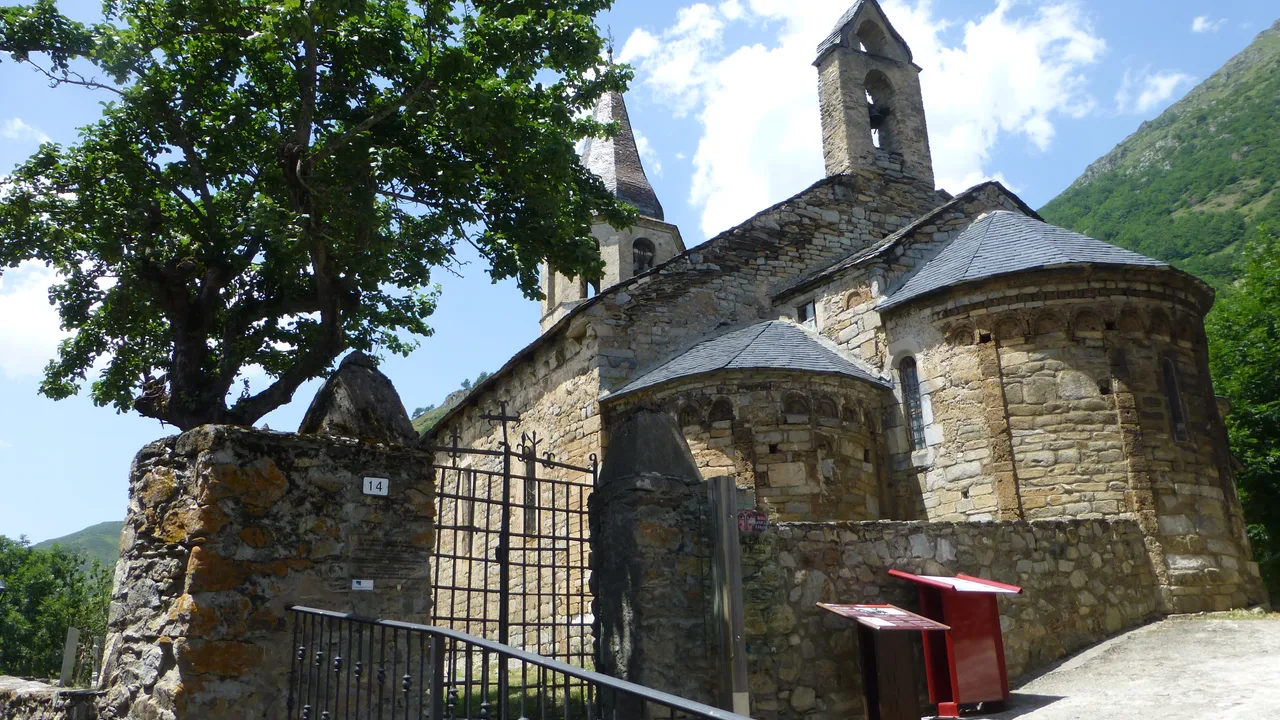
A short step above Salardú, tiny Unha is worth the detour for its church of Santa Eulària — a three-nave Romanesque building with a Lombard-style triple apse and an 18th-century belfry, and the only church in the whole Val d'Aran that still preserves its Romanesque wall paintings, in the half-dome of the central apse. It's the church pictured at the top of this guide.
Bagergue
Bagergue, above Salardú, is the highest permanently-inhabited village in the Val d'Aran and, since 2019, the first Catalan village named one of Spain's Most Beautiful Villages (Los Pueblos más Bonitos de España) — steep stone lanes, the Romanesque church of Sant Fèlix, and artisan cheese.
Vielha
The valley capital, Vielha, at 974 m, is the largest town and services hub, with the church of Sant Miquéu and its Crist de Mijaran and the Aran museum. Practical, and the gateway through the year-round tunnel.
Bossòst
Down in the lower valley (Baish Aran) near the French border, Bossòst is a lively little town best known for its 12th-century church of the Assumpció (Aranese Mair de Diu dera Purificacion) — one of the best-preserved Romanesque churches in the whole Val d'Aran, a three-naved basilica whose north doorway carries a black-marble tympanum of Christ in Majesty. It's also a popular stop for cross-border shopping and an easy hop into France.
The midsummer fire festivals
If you're here around St John's Eve (23 June), don't miss the valley's most spectacular tradition. In Les the Crema deth Haro and in Arties the Taro each burn a ~12-metre fir trunk — cut and planted in the square the year before — in a blaze of Aranese dancing that traces back to old solstice purification rites. Both are part of the "summer solstice fire festivals of the Pyrenees," inscribed by UNESCO as Intangible Cultural Heritage of Humanity — a rare living link to the valley's pre-Christian past.
Frequently Asked Questions
What language do they speak in the Val d'Aran?
Aranese — a variety of Gascon Occitan — is the valley's own language. Since the 2006 Statute of Autonomy it has been co-official across the whole of Catalonia alongside Catalan and Spanish, with preferential status in the Val d'Aran itself — making Catalonia the only place in the world where Occitan holds official status (even in France, home to most of its speakers, it has none), with the Val d'Aran as its native home.
Which is the prettiest village near Baqueira?
Salardú and Arties are the most characterful close to the lifts, while Bagergue, the highest village in the valley, is regularly named among Spain's most beautiful. All have Romanesque churches and stone-and-slate houses.
Can you visit the villages without skiing?
Yes — the villages are lovely to wander year-round, linked by the ski buses in winter and the valley roads in summer, with churches, thermal baths at Arties, and excellent restaurants.
Where can you see Romanesque wall paintings in the Val d'Aran?
In the church of Santa Eulària at Unha, above Salardú — the only church in the valley that still keeps its original Romanesque wall paintings, in the half-dome of its central apse. It's one highlight of the valley's wider "Aran Romanesque route" through its 33 village churches.
What are the Val d'Aran fire festivals?
On St John's Eve (23 June), the villages of Les (the Haro) and Arties (the Taro) burn a roughly 12-metre fir trunk in the square amid Aranese dancing — a solstice tradition with ancient roots, inscribed by UNESCO as part of the Intangible Cultural Heritage "summer solstice fire festivals of the Pyrenees."